“Enrico Fermi created the world’s first nuclear reactor, and years later, became famous for asking why we hadn’t detected life out among the stars. Little did he know his greatest scientific feat was the answer.”
~The novel Motus, by P. A. Kramer
Of course, Fermi wasn’t the first to create a reactor out of natural uranium. That honor goes to nature, some 3-4 billion years ago. But these extremely rare natural reactors are more than just a geological fluke. They could be the origin of life on Earth and the answer to whether we are alone in the universe.
The Fermi Paradox.
Sci-Fi authors have gone to great lengths to explain away the abundance of advanced alien life in their books. The reality is, if aliens were so common, we should see evidence of their civilizations. But we don’t, and that is the heart of the Fermi Paradox.
There are many plausible solutions to the Fermi paradox. Many of these center on the destruction of civilization in catastrophic events. These late “great filters” spell the end of life. But what of early great filters, events that prevent life from ever getting started?
For the origin of life to be the bottleneck for the development of alien civilizations, it implies that the conditions for life to emerge must be specific, selective, and rare. In other words, maybe Earth just got lucky.
The Rare Earth Hypothesis.
There are many orbital and geological features that make Earth ideally suited for sustaining life. But I will focus on the chemistry of life and what early Earth environments could have made it possible.
Origin of Life researchers have posited many theories for the origin of life on Earth and other planets. The RNA world hypothesis, for example, describes how the abiotic synthesis of RNA could have occurred, and how its stabilization and polymerization could have led to the first genetic storage medium and enzymes or ribozymes. Other hypotheses abound to explain the origin of metabolism, proteins, and cell membranes under the umbrella of prebiotic systems chemistry. They all have one thing in common, an environment with an energy source (heat or radiation), a supply of nutrients and reducing gases to participate in chemical reactions, a means to contain or concentrate them, and time. Hydrothermal systems, tide pools, warm ponds, and volcanic springs are all plausible candidates, but each has its drawbacks.
But if this was all it took to create life, why did it arise only once? None of those environments sound out of place on a Hadean or post-Hadean Earth or even other planets in our Solar system. But evidence from genetic studies suggest we, along with every other organism on Earth, share a Last Universal Common Ancestor, or LUCA. This points to a much rarer environment as the origin of all life on Earth. Such as a natural reactor.
Natural reactors.
Enrico Fermi’s reactor (The Chicago Pile-1) used unenriched uranium, which contains only 0.7% of U-235, the fissile uranium isotope responsible for sustaining a nuclear chain reaction. For nature to do the same, it had to occur billions of years ago, when the U-235 isotope concentration was 3-4x higher. Even then, this event was so rare, we only have evidence of it occurring once in all of Earth’s geological history. Two billion years ago, in what is now Oklo, Gabon, West Africa, one such natural reactor went critical and stayed intermittently active for hundreds of thousands of years.
The Nuclear Geyser Hypothesis.
The nuclear geyser hypothesis is a relatively new theory with few of the shortcomings present in other origin of life models. For one, a natural uranium reactor has a diverse energy source (heat, ionizing radiation, and free electrons) which is long lasting, abundant, self-regulating, and cyclical, all of which favor the formation of complex organic molecules. A geyser or underground cavity would help confine the organic molecules and aid in their synthesis by trapping gases such as CO2, CO, CH3, H2 (formed by radiolysis), and others. These gases are the precursors to the synthesis of carbohydrates and hydrocarbons at high enough pressures and temperatures, especially in the presence of catalysts like calcium and nickel within the rock (see Formose reaction, Sabatier reaction, and Fischer–Tropsch process). These and other elements, such as sulfur and phosphorus are also commonly associated with uranium deposits and essential for life.
After overcoming the energetic barrier to their formation, organic molecules need a place to cool and assemble. Because water is a neutron moderator, its presence would kick off the fission chain reaction of U-235. When this water boiled away or gas voids formed in the earthen substrate, the reaction would halt altogether until it had cooled, allowing water to seep in again. This cyclical and temperature-regulating feature of natural reactors would have allowed organic molecules like RNA to polymerize and form double strands in the surrounding rock. During the next wave of heat, the double strand would denature, opening up the exposed bases to new and complimentary nucleotides. The RNA that possessed the greatest stability or that facilitated a beneficial enzymatic function, would have persisted longer, thus creating more copies of itself. Complexity would have inevitably followed and could have led to the first protocells.
Natural Uranium Reactors as a solution to the Fermi Paradox.
The Nuclear Geyser Origin of Life Hypothesis, or some version of it, is a great candidate for a Fermi Paradox solution for four simple reasons. It is:
Time limiting- Due to the 704 million year half-life for U-235, alien life has a limited amount of time to evolve, while U-235 is still at a high enough concentration for a natural reactor to be feasible (2-5%). Assuming the ratio of U-235 to U-238 is similar across other star systems, life would have to emerge within 2.6 billion years of the formation of the star system. Any delays in planet formation, cooling, tectonic activity, and the condensing of liquid water could have made life impossible.
Selective- A potential life-baring planet would need to be formed in the remnants of a Type II supernovae or neutron star collision to form elemental Uranium. The planet would need to be of sufficient size for atmospheric and geological activity to deposit uranium in sufficient amounts.
Rare- With only one example of a natural reactor on Earth, it is a decidedly rare environment with the appropriate conditions for life to emerge.
Non-exclusive- Since this is an early filter, it applies only to the start of life on a planet. This leaves room for other great mid-late filters to be at play, including the nuclear destruction of alien civilizations by the same uranium that that gave them life.
What do you think? Could Enrico Fermi’s greatest scientific accomplishment, a natural uranium reactor, also be the solution to his famous paradox? Let me know in the comments.
Other considerations.
The original authors for the Nuclear Geyser Hypothesis make some well-supported claims, though not everything holds water in my opinion. The elaborate on certain key points in a follow-up article (chapter 13).
Low sodium environment– Firstly, the authors claim low sodium environments are necessary for life, though at first glance, this appears to be based on the fact that modern life almost uniformly rejects sodium in favor of potassium in the cytoplasm of cells. The transport of sodium out of the cell is essential to maintaining cell volume, osmotic balance (i.e. where sodium goes, water follows), the ability of cells to induce chemical gradients for excitation, and for the co-transport of nutrients into cells against their concentration or electrochemical gradients (E.g. symporters like the sodium glucose transporter). However, I don’t see any reason why this would inhibit the formation of the first protocells. Indeed, this adaptation may have come about later in evolutionary history, perhaps even before LUCA due to the above advantages.
When I emailed the corresponding author of the paper, Shigenori “Singe” Maruyama, about this, his response was very honest. Singe, retired now at 75, admitted this Na-poor environment requirement for the early formation of life was largely centered around earlier investigations into geysers, citing the work of Armen Mulkidjanian. However, this work leans heavily on the “chemistry conservation principle,” an assumption that the chemistry of modern life was conserved since its inception. Yet this assumption cannot exclude advantageous adaptations that occurred early in evolutionary history and was conserved from then on. Our last universal common ancestor was not our first common ancestor and may have been far removed from the original protocells that formed in the cradle of life. Indeed, LUCA is a theoretical organism that shared approximately 300 genes with all of its descendants. But those genes were made of DNA and coded for fairly sophisticated proteins and enzymes. The ancestor of LUCA, the first protocells, were more likely to be RNA based and use ribozymes. Thus, there may have been a window of hundreds of millions of years before LUCA emerged with its preference for Na-poor environments.
Regardless, nuclear geysers were most likely Na-poor, making this an even stronger candidate for the origin of life.
Phosphorus supply- Phosphorus is an element critical for life as we know it. It makes up the backbone of RNA and DNA as well as the “energy storage molecule” ATP. Since phosphorus and uranium often deposit in a similar fashion, this isn’t a critical issue on Earth, but other settings and planets are likely to have a phosphorus problem. The flux of thermal neutrons in a natural reactor might be the solution, as a primary source of phosphorous is the absorption of thermal neutrons by silicon, one of the most abundant elements in the crust. This process is well understood in semiconductor science, as it is occasionally used to dope phosphorus in silicon crystals in a process called Neutron Transmutation Doping. During this process, a neutron will be captured by Si-30 to form Si-31, which will beta decay into P-31. Theoretically, this could supply small amounts of phosphorous to the rock surrounding natural uranium reactors to facilitate life.
A geyser or not a geyser-A geyser allows for the enrichment of water with atmospheric gases, a cyclic nature, and easy distribution of life-forms across the surrounding environment. But it does not appear a geyser is a necessary feature for life in a natural reactor. Far underground and beneath the water table, a natural reactor could sustain its own cyclical activity through the boiling away of water and the formation of voids, and the radiolysis of water and heated rock would provide and confine oxygen, hydrogen, nitrogen, and carbon dioxide far better than were it allowed to vent into the atmosphere. Distribution of the lifeform across the environment could have happened in several ways, such as a meteorite impact, earthquake, or the slow seeping of protocells through the rock. The latter would give it time to evolve gradually to changes in its environment and the steady waning of resources as it moved further from its origin.
In Fiction.
I have yet to see this particular solution to the Fermi paradox in fiction. Though that is about to change.
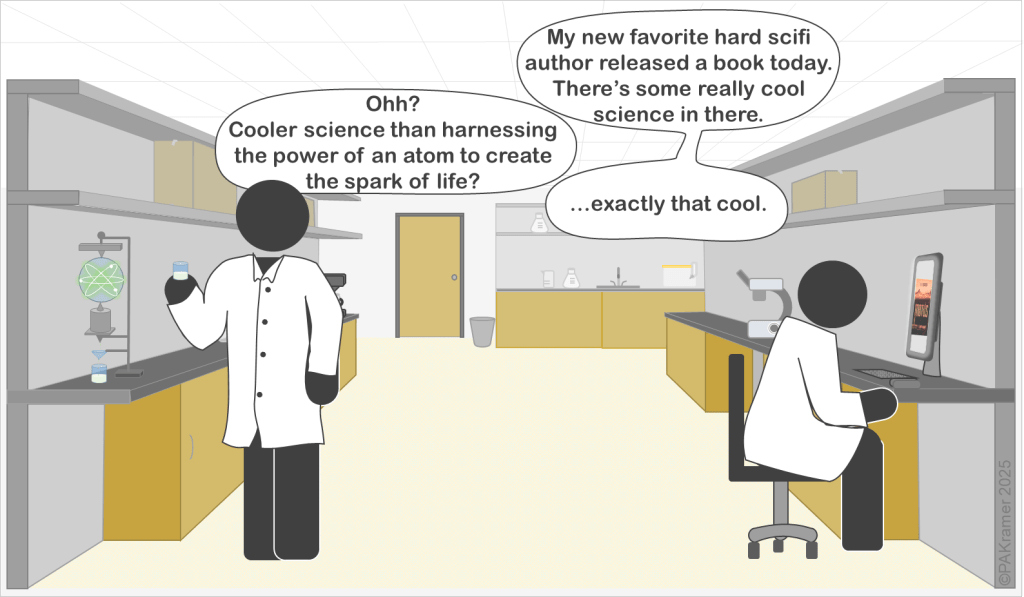
In my novel, Motus, an underground city on Mars discovers life 5km beneath the surface near a deposit of uranium, ore they desperately need to keep their city going. The existence of this simple life-form is what spurs the surface colonists to come to the city’s rescue, as they have been unable to find any sign of life on the surface.
Being a hard sci-fi novel, Motus also discusses topics like in situ (and in motus) resource utilization as well as ecosystems and life-support requirements in an underground colony far from common energy sources and with limited space.
Isaac plugs Motus at the end of the episode and adds this little gem, which pretty much encapsulates this website and all my writing goals:
“…it’s exactly the kind of imaginative leap we need. Science thrives when fueled by creativity, and science fiction helps us envision the strange and wonderful outcomes of ideas like these—not just as thought experiments, but as living, breathing worlds.”


Pingback: The Fermi Paradox – Did a Natural Nuclear Reactor Spark All Life? | Zand Space