I will be releasing my debut hard sci-fi dystopian novel, Motus, this October.
Many of you may recall from my July writing update, that I decided to pursue the independent publication of my novels, including Motus and Upended.
I’ve already made significant headway.
I was recently presented with an excellent promotional opportunity and wanted to take advantage of the timing by scheduling the release of one of my books. Upended is ready to be published, but I really wanted Motus to be my debut. The problem is, it has been sitting in a publisher’s slush pile for 10+ months. So when I heard they still needed time to get to it, I asked them to withdraw my novel from consideration.
While I still hope to be traditionally published one day, I was not ready to spend another couple of years waiting for my first book to get out there. Instead, I intend to publish Motus myself and in time to take advantage of the above-mentioned promotional opportunity (more on that in a future post).
The Book.
Having fallen off social media and this blog the past couple years, I never spoke publicly about Motus while writing it. So here is some backstory. It started off as a thought experiment, trying to imagine what politics would look like in an underground colony on Mars. When think of our own “left” and “right” party system, I imagined instead an “up” and “down” party system. Instead of liberal vs conservative narratives, these Ascensionists and Descensionists would argue over which physical direction to move their colony. Centrists in this scenario are known as Lateralists. Here is an excerpt from the book that explains it within the narrative:
More often than not, a person’s political leanings were evident by the jobs they worked. Ascensionists, who would have the city move at an upward grade, were quick to recruit miners, haulers, and compactors, who found gravity a helpful assistant in their labors. Descensionists were just the opposite and appealed to those in the Foredistrict who liked the idea of saving shares on heat and haulers by rolling their impractically heavy houses downward and into warmer rock. The disagreements that raged between the two parties of extremes held little sway with Lateralists, who made up the majority of Motus’ shareholders. They favored the status quo, moving the city at a net zero grade.
Naturally, this concept expanded as I crafted a world and plot around it. I needed to come up with a history for this colony, even if the residents had long since forgotten their origins, and I needed to make it realistic, for there is a lot of science required to keep an enclosed ecosystem operational. Thankfully I did much of this research already when preparing the article “Enclosed Ecosystems and Life Support System in Scifi” for Putting the Science in Fiction.
Most importantly, I had to give the underground city a reason to keep moving, otherwise their political leanings based on direction would be meaningless. That didn’t take long to figure out either. In situ resource utilization is a concept repeated regularly in the context of planetary colonization. But it has its limits. For example, what if the resource a colony needs isn’t visible or within easy reach. They would have to go looking for it, testing the rock as they went to see if it contained the minerals or elements the colony lacked. Here is another excerpt:
… the city had only ever risked true catastrophe when it ceased moving altogether. Every few decades, they would chance upon rock laden with valuable resources. Every time, they would halt all forward progress and mine as much as they could, sometimes for months. But the rock was always deficient in something, be it uranium, water, oxygen, phosphorus, sulfur, or dozens of other minerals and metals needed to keep the city operating. When that resource became critically low, they would hobble forward again, crossing their fingers they would find what they needed before that part of their infrastructure collapsed and a cascade of failures ensued.
And so instead of in situ resource utilization, they operated on in motus, or in motion, resource utilization. And so that was how the underground city received its name.
With all that setup, I present to you the back cover blurb:
For centuries, the people of Motus tunneled through the rock in search of the resources they needed to survive. Until Corun, armed with his late father’s pickaxe, uncovers an unfamiliar ore in the underground city’s path.
Far from the windfall he was expecting, the ore is identified as slag from the furnace, rock long ago stripped of its useful water and oxygen. It could only mean one thing.
They’ve been moving in circles.
When faced with the prospect of retracing their steps, the city’s laborers go on strike. Corun, inspired and captivated by an outspoken compactor, believes their only hope lies above them. Even as resources become scarce, they are determined to see what, if anything, is up there. But they will have to contend with cold rock, thin air, and a jaded board member impeding their progress at every turn. And what they find will test their wits and resolve and make them question everything they were ever told.
Comp titles:
Reminiscent of Wool and City of Ember, with an adult, hard sci-fi twist, MOTUS explores the travails and triumphs of a people determined to carve an existence out of cold and unforgiving stone.
Concept Art.
Being an indie author might be a lot of work, but it’s also a lot of fun. It gives me the excuse to get on social media and reach out to authors, artists, and editors for advice or services. These are all great people, and I automatically feel closer to them due to our mutual struggle to stand out above all the AI slop invading the publishing space.
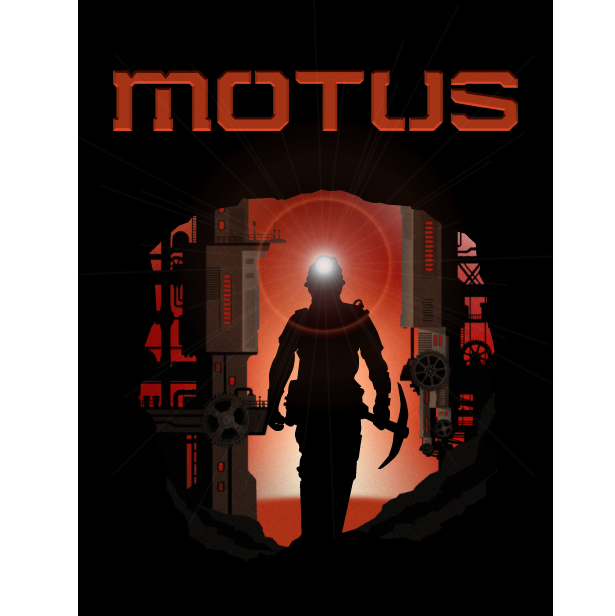
So far, I have commissioned several artists to produce amazing concept and character art for me, which I hope to plaster liberally over social media in the coming months. Here are just 2 of them. I’m saving the character art and cover reveal for when my book is available for preorder.

Pre-order campaign.
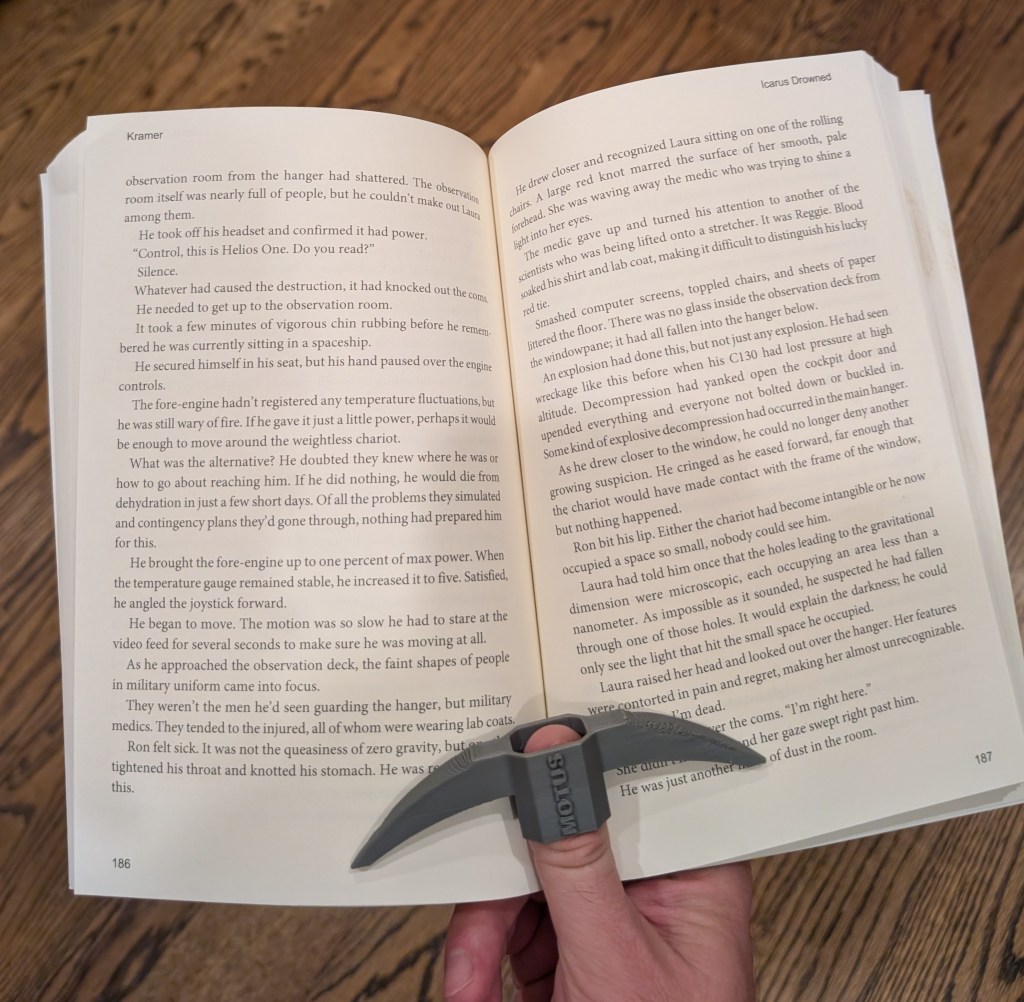
Because a book’s success largely depends on the first few weeks of sales, I will also be announcing a pre-order campaign. If you would like to support my book launch, please be sure to subscribe and follow me on social media (p.a.kramer on Instagram and Threads) so you don’t miss the preorder announcement. I would like to offer exclusive merch to those who pre-ordered, including t-shirts, character art, and reading accessories. Here is just one piece of custom book swag I created, a thumb page holder that looks like a pickaxe:


More details to follow in a future post.
ARC readers.
If you are interested in obtaining a free copy of the book (ebook or print ARC) in the month prior to its official release in exchange for an honest review, please reach out to me through the contact page. Please only request an ARC if you regularly read and review Scifi.
Motus Audiobook.
For all of you who consume your books via audio narration, I also plan to hire a narrator on ACX as soon as the book is available for preorder. Depending on how long the auditions, production, and approvals take, the audiobook will be available for purchase on release day or within a month or two after.
Release date.
Currently the book is in the hands of my editor, but I should be able to incorporate their edits and make the book available for preorder by the middle of August. It will be available for preorder on all the major platforms (Amazon, Barnes and Noble, Kobo, etc.).
The release will be scheduled for early-mid October.
Until next time, write well and science hard.

Great work Phil! I’m stoked for your self-publishing journey and can’t wait to read Motus. That thumb pickaxe is awesome too, will preorder!
LikeLiked by 1 person
Thank you so much. I appreciate any support I can get during my first book release. Being an indie author isn’t easy.
LikeLike
LOL, this is actually Bryan Tully not Marc Erickson. I was trying to help him set up a WordPress account like 15 years ago and never realized until now that my email address was attached to his name.
LikeLiked by 1 person
Bryan! You know you don’t have to pay for my books. You’re basically family.
LikeLiked by 1 person