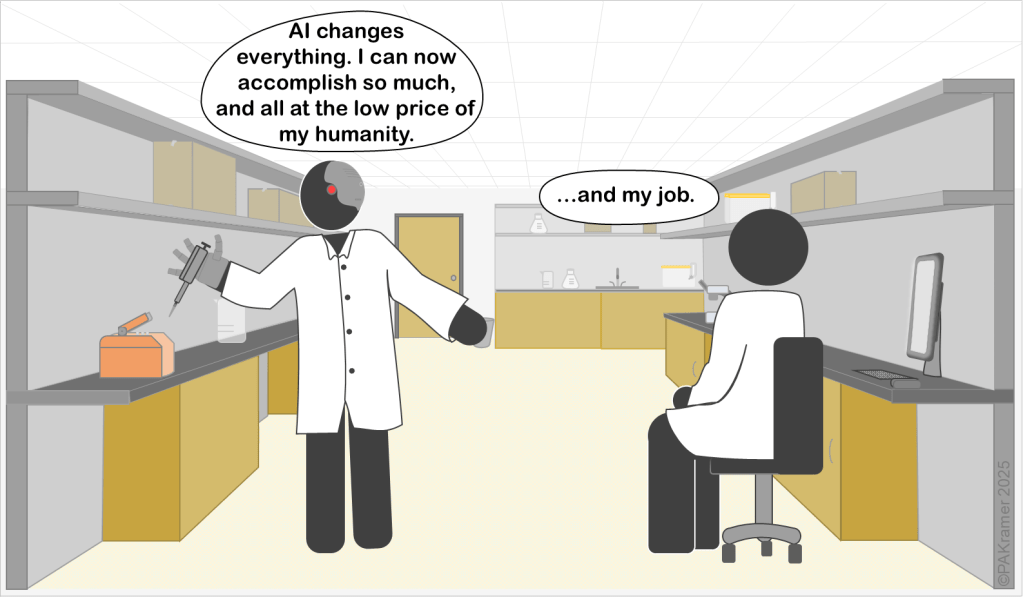
There are so many arguments for and against generative AI in writing, art, and other creative endeavors, I can’t even pretend to have considered them all. However, I have collected enough observations to formulate a hypothesis. I also invite you, my peer reviewers, to let me know what conclusions are problematic and what confounders I failed to account for.
“But AI is just a tool” argument.
This is the most common argument I’ve heard in favor of AI. Some liken it to the advent of photography, which was similarly hailed and condemned when it became widely available. It too was sure to replace artists, they cautioned, who would no longer be commissioned to paint portraits or landscapes. While it undoubtedly affected the industry in negative ways, it also spawned a whole new form of art, benefited society in countless ways, and artists were still highly valued, and their paintings praised. That is largely where this argument begins and ends. But this is a false analogy.
AI is nothing like photography. For one, photography can’t create things that aren’t there. You can be creative in how you use the tool, but it doesn’t create or replace creativity. Bringing something into the world that was previously imaginary requires a tool and an artist. AI is not just a tool; it is the artist. In fact, it is an entire digital multimedia studio staffed by a team of writers and artists. AI can functionally replicate all forms of creative expression and in any style or medium without much, if any, human involvement. Prompting the AI barely qualifies as “involvement,” as creativity extends well beyond the inception of an idea, but the act of bringing it into existence. If this wasn’t true, then that would make me the rightful owner of any story written by a writer who followed my creative writing prompt. Every word or stroke of the brush requires a creative mind behind it, and generative AI removes that creative mind from the equation.
While I agree that the desire for human-made art and writing will likely provide a small niche for artists and writers even if AI were to become mainstream, unregulated, the damage it can do will cripple most creative industries. It’s already happening. Not only does AI replace artists and writers, driving people out of work and other opportunities, it is trained on their art and writing without consent or compensation. We know that because we can see it use other peoples’ art and writings in its renderings. One of the most popular examples is the clock. At least in earlier versions of generative AI, creating a clock that read anything other than 10:10 was impossible for the simple reason that it was the standard aesthetic used in watch advertising. Generative AI isn’t original, but an amalgamation of largely stolen content.
However, I do think there is a time and a place for generative AI. It certainly has the potential to benefit society as a whole, especially in performance of menial and non-creative tasks. Research and education, for example, are all about data processing, handling, and communication, which largely don’t require creativity. These are things that will generally benefit humanity instead of driving it into irrelevance. I’m all for technological advancement, but for the same reason I don’t think it’s wise to create a super virus, I think creating an unrestricted AI will have the potential to hurt society more than it benefits it.
“Everyone knows AI when they see it” argument.
A brief scroll through Bookstagram, BookTube, and BookTock will provide all sorts of evidence to the contrary. They usually center around authors who were found to have used generative AI in their cover art and in their writing. These instances most commonly came to light after a reader found AI prompts still embedded in the text of the book along the lines of “I wrote this scene in the style of so-and-so, and can emphasize this or that…” Had they managed to successfully delete these prompts, readers would have never known (maybe suspected) the authors were using AI to generate huge amounts of content. It is also easy to find content creators offering advice on how to write books with AI without making sound like AI. There was even a BookBub survey of 1,200 authors where ~27% of authors use AI for writing, and about 74% of them never disclose it to their readers. While there is likely bias, especially toward self-published authors in this survey, it’s safe to say that if you are a prolific reader, you’ve likely read AI writing without realizing it.
From what I’ve seen of AI quality, it is already better than many writers and artists and can generate weeks’ worth of effort in seconds, effectively kicking creatives out of the market and saturating it for everyone else. Only the best writers and artists have a place (for now). And if even I, an author who has won awards, have felt discouraged and lost motivation due to the rise of AI books and cover art, then I imagine it has driven away many new and aspiring authors and artists from pursuing those career paths. The quality of AI is mostly irrelevant, anyway. There are plenty examples of poorly written books with a large fanbase. If it succeeds in drawing readers away at all, it is harmful to real human writers.
“Being Anti-AI is ableist and classist” argument.
As with all areas of life, people with lots of money or who are able-bodied and normo-cognitive, have an advantage over everyone on the left side of the bell curve. Those with pockets deep enough to pay for the full editing package, ghost writers, cover illustrators, and book marketers, or are talented enough to do it all themselves, make it much harder for people without the wealth and skill to compete. It would be great if there was a “tool” that could level the playing field, allowing anyone to write great books and generate amazing covers.
The issue with this argument is that AI isn’t the magical tool they think it is. For one, AI also costs money, money which goes to bloated corporations instead of hard-working writers, artists, and editors in the book industry. Secondly, if you’ve written a book, you’ve already likely invested a lot of time and some money. There isn’t a single business venture out there that doesn’t require an investment of some form in the hopes it will pay off and make that money back for you. It’s terrible that the investment risk is greater for some more than others, but that age-old societal problem can’t be fixed with AI without shifting the burden onto others even less fortunate. There is only so much demand for books, so the more that demand is filled by AI generated content, less will make it into the pockets of artists and authors who created the content themselves. Additionally, the ability of AI to write and create art would not have been possible without the original writing and art that was used to train it. For the most part, that valuable training material was taken without consent.
The aforementioned BookBub survey also showed that the majority of authors who refused to use AI did so because they considered it unethical. So, in short, being anti-AI in creative endeavors is not classist and ableist, it is humanist. It rewards the creativity and agency of people rather than the corporations who stole their art and writing to train an artist, editor, and writer replacement.
Brainstorming and editing.
Some authors use generative AI for brainstorming and editing. In my opinion, so long as it is purely technical, I am not opposed. In other words, so long as the author would have come to the same solution to a grammatical error or plot hole with a bit more scrutiny and research, generative AI isn’t creating anything substantive but is being used to educate. However, if the “brainstorming” extends to the broader details of the story, coming up with plot and character arcs, outlining scenes, and generally creating the substance of a story while the author fills in the gaps, the writer is no longer the creator of the story. The same applies to generative AI performing developmental and line edits that fundamentally change the story and voice. If an author needs substantial help with their story, I recommend hiring an editor. Their livelihood is also on the line, and at least the substantive changes they suggest to your story would at least be human in origin.
What do we do about it?
We need to proceed with caution. Like other technological innovations, it will be important to continue the dialogue and assess where this technology fits into society for the benefit of everyone, not just a few, and to avoid harm. And like it or not, the amazing benefits of generative AI come with the potential for widespread harm.
Regulations that slow the role-out of generative AI will give us time to consider its place in society and evaluate and correct any harm it has done. Restrictions that prevent people from monetizing AI and claiming copyright will also disincentivize its use and abuse in creative industries. And if stripping monetization isn’t possible, then laws that require funds be sent to all the artists and writers who consented for their work to be used to train the generative AIs would at least compensate the original creators.
In summary, my objections to generative AI aren’t because I am averse to change, but because I am opposed to harm. Technological advancements can only advance our society if they aren’t hurting it even more. Generative AI in creative industries is largely harmful, but it does have its time and place. We just need to figure out where it fits in the patchwork of our society without tearing the seams.
